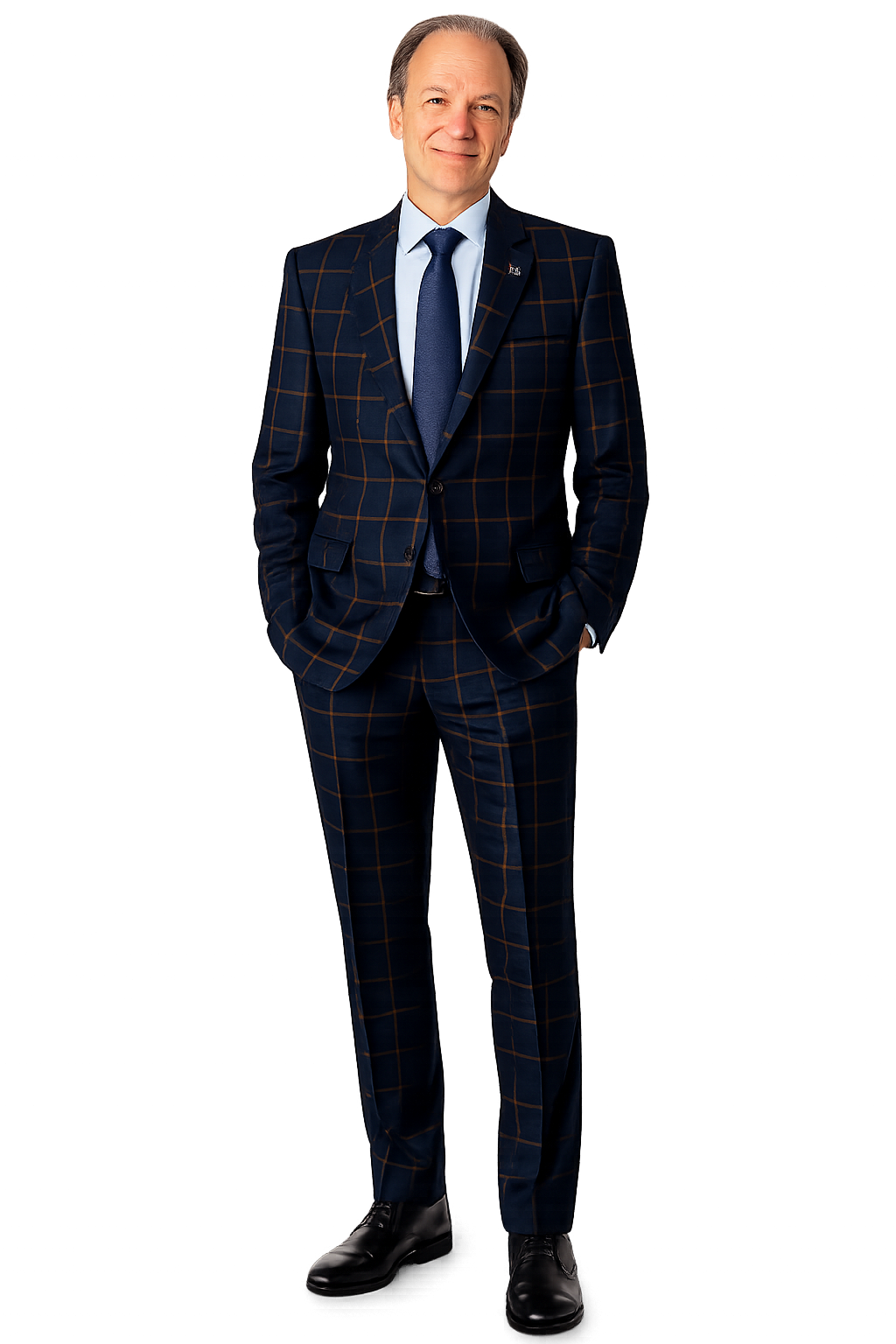
Mining Pioneer · Philanthropist · Art Collector
Co-founder of Franco-Nevada Corporation, whose royalty model transformed mining finance. One of Canada's most consequential arts philanthropists — and a collector whose passion has shaped institutions from Québec City to Toronto.
From Saint-Hyacinthe to the summits of global business and arts philanthropy.
Pierre Lassonde OC GOQ was born in 1947 in Saint-Hyacinthe — third of four children in a family of both entrepreneurs and patrons. His mother Juliette filled their home with artists; his father built a manufacturing enterprise. Both currents flow through the man he became.
He earned a BSc in Electrical Engineering from École Polytechnique de Montréal (1971) and an MBA from the University of Utah (1973), later adding the CFA designation. Work at Bechtel and Beutel, Goodman led him to Seymour Schulich — and to a partnership that reshaped mining.
With Seymour Schulich, pioneers the gold royalty and streaming model — buying a $2M royalty on a Nevada mine that ultimately generates over $1 billion. Shareholders earn a 36% annualised return over 20 years.
Begins collecting Quebec art seriously — first Clarence Gagnon, then his first Riopelle. A private passion takes shape alongside a public career.
A landmark three-way deal values Franco-Nevada at ~US$3.2B. Lassonde becomes President of Newmont and Chair of the World Gold Council (2005–2009).
Acquires Newmont's royalty portfolio for US$1.2B and relaunches Franco-Nevada — the largest mining IPO in TSX history. At its peak: US$38 billion valuation.
Leads a decade of transformation at the MNBAQ. Donates $10M and leads a $110M campaign for the Pierre Lassonde Pavilion — designed by OMA (Rem Koolhaas).
Under his five-year tenure the Canada Council's annual budget doubles to $360 million — the most significant arts funding expansion in Canadian history.
Donates 60+ Riopelle works (valued at $100M+) and $20M cash to fund the Espace Riopelle at MNBAQ — opening October 2026. Keeps three: "one for each of my children."
The Foundation commits $50M to Polytechnique Montréal (Institut Pierre Lassonde) and $25M to the Lassonde Entrepreneur Institute, University of Utah.
A career built on a single insight: royalties are better than mines.
Lassonde and Seymour Schulich invented the gold royalty model by adapting the oil-and-gas structure to gold for the first time. Instead of operating mines, collect royalties on others' production — capital-light, operationally lean.
The original $2M Nevada royalty became a $1B+ revenue stream. Relaunched in 2007 as the largest mining IPO in TSX history — peak valuation: US$38 billion.
Following the 2002 three-way merger, served as President of one of the world's largest gold producers until 2007.
A foundational framework describing mining company valuation through discovery, development, production, and decline — taught in mining finance courses worldwide.
Where does capitalism draw its oxygen? It's from innovation, from creation — from the bottomless well of human imagination. Which is the same as what artists do.
Transforming cultural institutions, funding the arts, and investing in human potential.
2023 Edmund C. Bovey Award · Business for the Arts — Lifetime Arts Philanthropy Recognition
A collection that traces the soul of Québec's artistic identity — and reaches beyond its borders.
The collection spans roughly 100 key paintings covering the full arc of Québec's modern art — from 19th-century landscape to postwar radical abstraction. Landscape dominates.
His juxtapositions are intentional: Gagnon beside Riopelle makes visible the dialogue between tradition and rupture. The 2016 MNBAQ exhibition 'A Private Passion' showed 100 works by 35 artists.
Riopelle holds a singular place. His first acquisition came in the 1980s; over four decades he assembled one of the most significant private Riopelle holdings — 60+ works spanning the full career.
In December 2021 the entire collection ($100M+) and $20M cash were donated to fund the Espace Riopelle at MNBAQ — opening October 2026. He kept three only: "one for each of my children."
Lassonde holds the largest private McNicoll collection — ~25 paintings — making him the foremost custodian of this Canadian Impressionist's legacy.
In 2024, he loaned ~25 works to the MNBAQ retrospective Helen McNicoll: An Impressionist Journey — several shown publicly for the first time.
To understand what drew Lassonde to the Automatists and Riopelle, one must understand African art — because the traditions are inseparable. In the very years Riopelle fragmented colour in Paris, Picasso and Braque were studying African masks to break Western pictorial convention.
African sculptural traditions — Benin bronzes, Dogon figures, Fang reliquary heads — share with the Québec avant-garde a commitment to formal rigour over decoration. A collector who holds Borduas holds, implicitly, the same values.
For media inquiries, partnership opportunities, or general correspondence.
Pierre Lassonde Family Foundation
Musée National des Beaux-Arts du Québec
Pierre Lassonde Pavilion
Montréal & Québec City, Canada